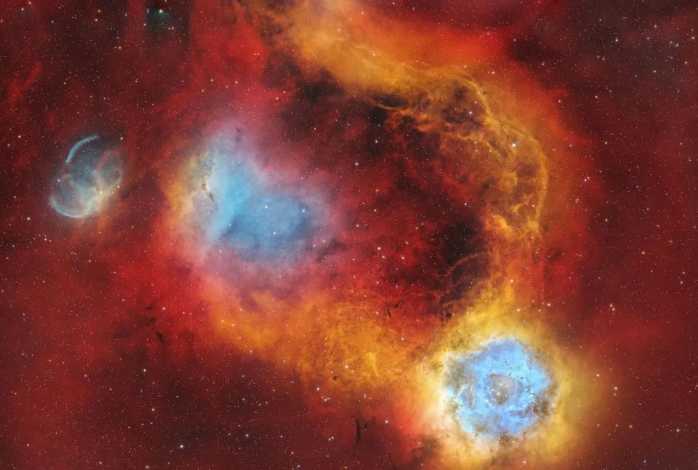
NGC 2237, the Rosette Nebula’s core, hosts the open cluster NGC 2244, whose bright blue stars unleash stellar winds and high-energy radiation. These forces carve out the nebula’s central cavity, pushing gas outward into the iconic petal shape. At 5,000 light-years away, the nebula spans three times the Moon’s diameter—an expansive stellar nursery where new stars ignite within its dusty folds.
The image’s gold filaments are dense dust lanes laced with hydrogen gas, while the blue-white hue stems from hot young stars ionizing surrounding material. This cosmic flower is not static: every 10 million years, supernovae from massive stars within NGC 2244 will reshape its "petals," triggering the next generation of star birth.
Visible through backyard telescopes in Monoceros (the Unicorn constellation), the Rosette Nebula shines at magnitude 6.0—bright enough for binoculars under dark skies. Astrophotographers use hydrogen-alpha filters to enhance its red glow, revealing details like the "hole" at its center, sculpted by the cluster’s collective stellar winds.
"Spectroscopy of NGC 2237 shows carbon, nitrogen, and oxygen enriching the nebula," says astronomer Dr. Lisa Dang. "These elements, forged in stellar cores, will seed future solar systems—making the Rosette a literal garden of cosmic life’s building blocks."
As telescopes peer deeper, the Rosette Nebula stands as a testament to the universe’s artistry: a 5,000-light-year-wide bouquet where stellar death and birth dance in an eternal cycle, hidden among the stars of Monoceros.