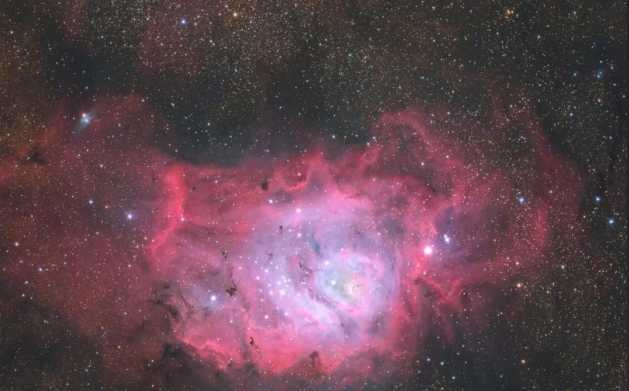
Located approximately 5,200 light-years from Earth, the Lagoon Nebula spans over 110 light-years across, making it one of the largest nebulae visible from Earth. It earned its name from a dark lane of dust that bisects the nebula, resembling a lagoon within a bright, turquoise expanse of ionized hydrogen gas. This dust lane is not just a visual feature; it plays a crucial role in the nebula's star-forming processes. Within M8, gravitational forces cause the gas and dust to collapse, leading to the formation of protostars. The nebula is home to several young, massive stars that emit intense ultraviolet radiation, ionizing the surrounding gas and creating the bright, glowing appearance captured in stunning astrophotography.
In close proximity to M8 lies another renowned nebula, the Trifid Nebula (M20). Often considered one of the most beautiful nebulae in the cosmos, the Trifid Nebula's name stems from its distinct three-lobed structure, created by lanes of dust that divide its glowing gas into segments. Together, these nebulae paint a vivid picture of the dynamic processes at work in the Milky Way, where the raw materials of the universe transform into stars and planetary systems. Both M8 and the Trifid Nebula are popular targets for astronomers and astrophotographers, offering a front-row seat to the universe's ongoing cycle of creation and renewal.