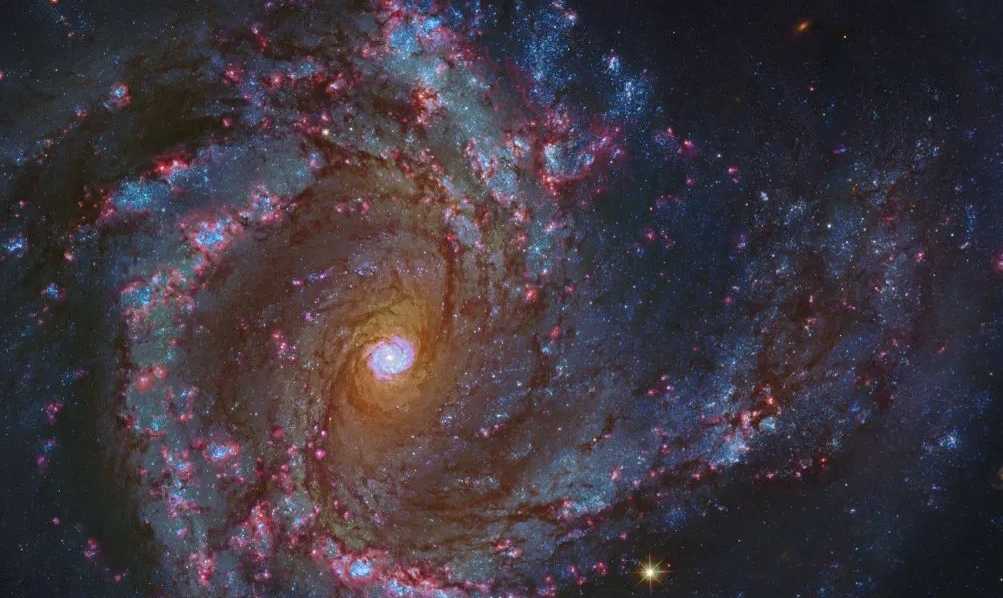
M61’s central region, just 1,000 light-years across, harbors an active supermassive black hole (SMBH) surrounded by a rotating disk of gas and young stars. This disk forms spiral-like nuclear arms, visible as bright blue arcs and pink star-forming regions. The structure arises from:
- Gas Inflow: Gravitational forces from M61’s central bar channel interstellar gas toward the core, triggering dense star clusters.
- Black Hole Feedback: The SMBH’s gravitational pull and occasional outbursts shape the gas into rotating patterns, similar to how a galaxy’s halo forms spiral arms.
Astronomers estimate the nuclear disk rotates at ~100 km/s, with star formation rates 10 times higher than the galaxy’s average. This mini-spiral isn’t unique—observations show ~20% of spiral galaxies host similar nuclear structures, but M61’s clarity makes it a prime case study.
Hubble’s high-resolution imaging resolved individual star clusters in M61’s core, while ESO’s spectrograms revealed the gas dynamics. Key findings include:
- Chemical Enrichment: The nuclear arms contain higher metallicity gas, suggesting recent star birth cycles.
- Merger History: The symmetry of the mini-spiral implies M61 may have absorbed a smaller galaxy in the past, whose remnant gas formed the core structure.
- Black Hole Connection: The SMBH’s mass (~50 million solar masses) correlates with the nuclear disk’s size, supporting theories linking galaxy cores and central black holes.
This cosmic "nesting doll" phenomenon challenges assumptions about galactic uniformity. As telescopes like JWST probe deeper, M61’s core serves as a reminder: in the universe, complexity often lies within complexity—from the grand spiral arms visible across millions of light-years to the tiny whirlpools dancing around supermassive black holes.